
MTC stands for Mill Test Certificate — a quality assurance document issued by a metal manufacturer or mill confirming the chemical composition and mechanical properties of a specific material batch. The MTC is the primary traceability document used throughout metals procurement and fabrication. It is required for material approval on oil & gas, marine, petrochemical, and structural engineering projects
Published: 2025-11-28 10:37:00
MTC Meaning: What Is a Mill Test Certificate and How to Read One
By akshai • Updated 2025-11-28 10:37:00 •
What does MTC stand for?
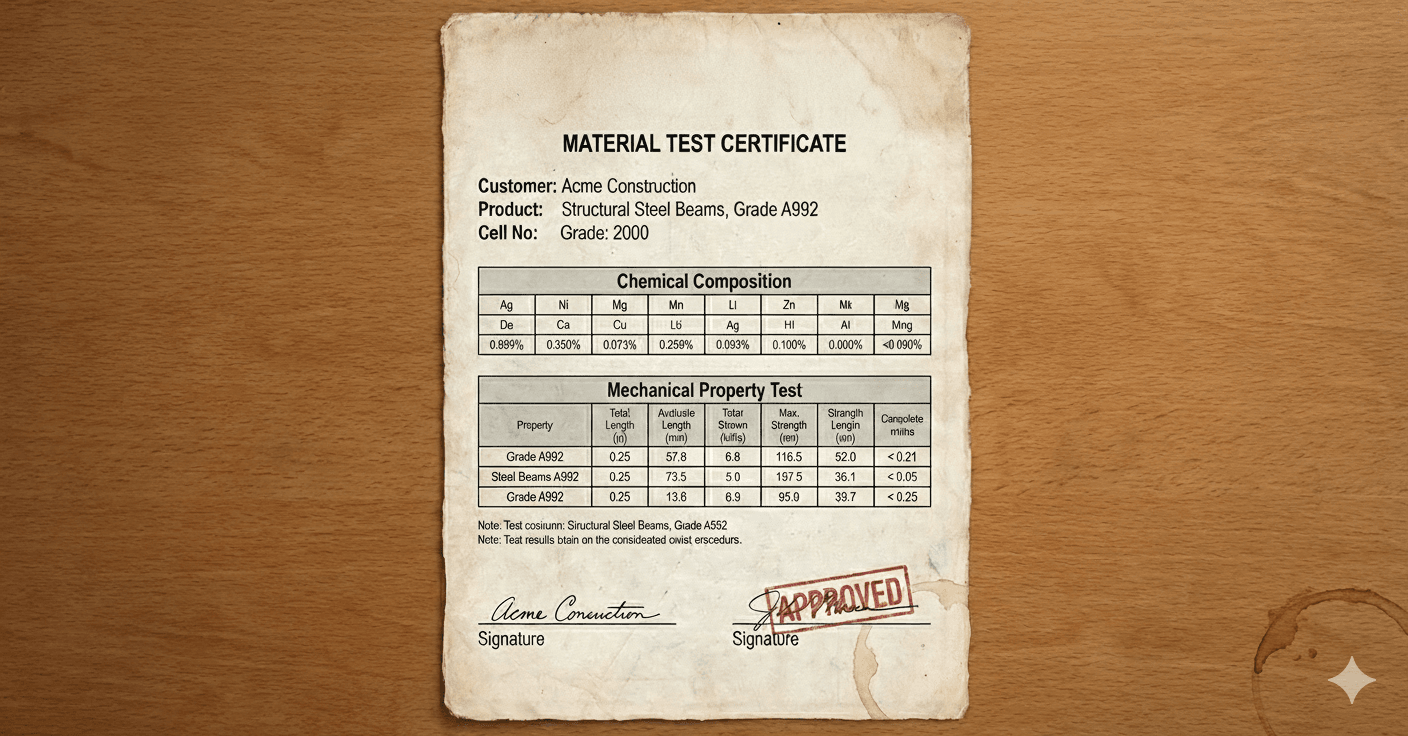
What an EN 10204 3.1 MTC contains
| Section of the MTC | What it shows |
| Heat / cast number | Unique identifier linking the MTC to the production batch |
| Chemical composition | Elements present (C, Mn, Si, Cr, Ni, Mo, etc.) as a % of mass |
| Mechanical properties | Tensile strength, yield strength, elongation, hardness (HB or HRC) |
| Heat treatment condition | Annealed, normalised, quenched & tempered, solution treated, etc. |
| Product dimensions | Size, thickness, diameter, and form (bar, plate, sheet, pipe) |
| Applicable standard | e.g. EN 10088, ASTM A276, BS 970, ASTM A240 |
| Inspector signature | Under EN 10204 3.1: signed by the mill's own inspection representative |
| Test results vs. specification | Confirms all values fall within the accepted range for the grade |
A Step-by-Step Guide to Reading a Mill Test Certificate
An MTC is dense with technical information. To read it effectively, you must understand what each section represents. Here is a systematic approach to decoding a material mill certificate.
1. Customer and Supplier Details
The top section of an MTC identifies the key parties involved. It typically includes:
- Manufacturer/Mill Name and Address: The facility that produced the material.
- Supplier/Vendor Information: The company distributing the material.
- Customer/Purchaser Name: The organization that ordered the material.
Verify that these details match your purchase order to confirm the document corresponds to your specific shipment.
2. Product Description
This section provides a clear description of the material. Key details include:
- Material Grade: The specific type of material (e.g., 316L Stainless Steel, Grade 5 Titanium).
- Product Form: The shape of the material (e.g., pipe, plate, bar, forging).
- Dimensions: Size specifications such as diameter, thickness, and length.
- Quantity: The amount of material covered by the certificate, often listed by weight or number of pieces.
3. Applicable Standards (EN 10204 / ASTM / ASME)
Every MTC must reference the standards to which the material conforms. This section lists the international or industry-specific specifications the material was produced and tested against. Common standards include ASTM (American Society for Testing and Materials), ASME (American Society of Mechanical Engineers), and EN (European Standards). The MTC will also specify its own type, most commonly under EN 10204.
4. Heat Number / Batch Number
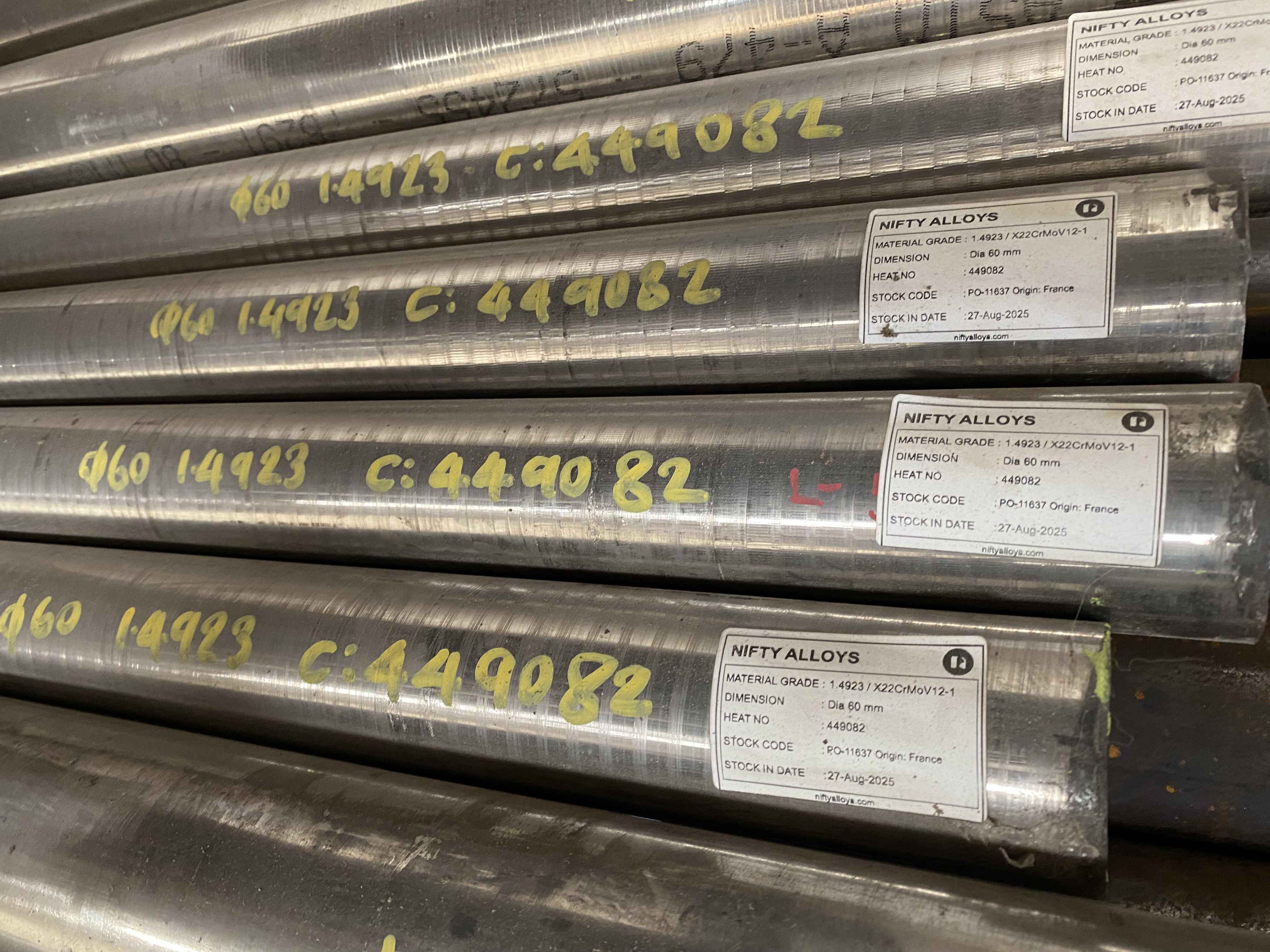
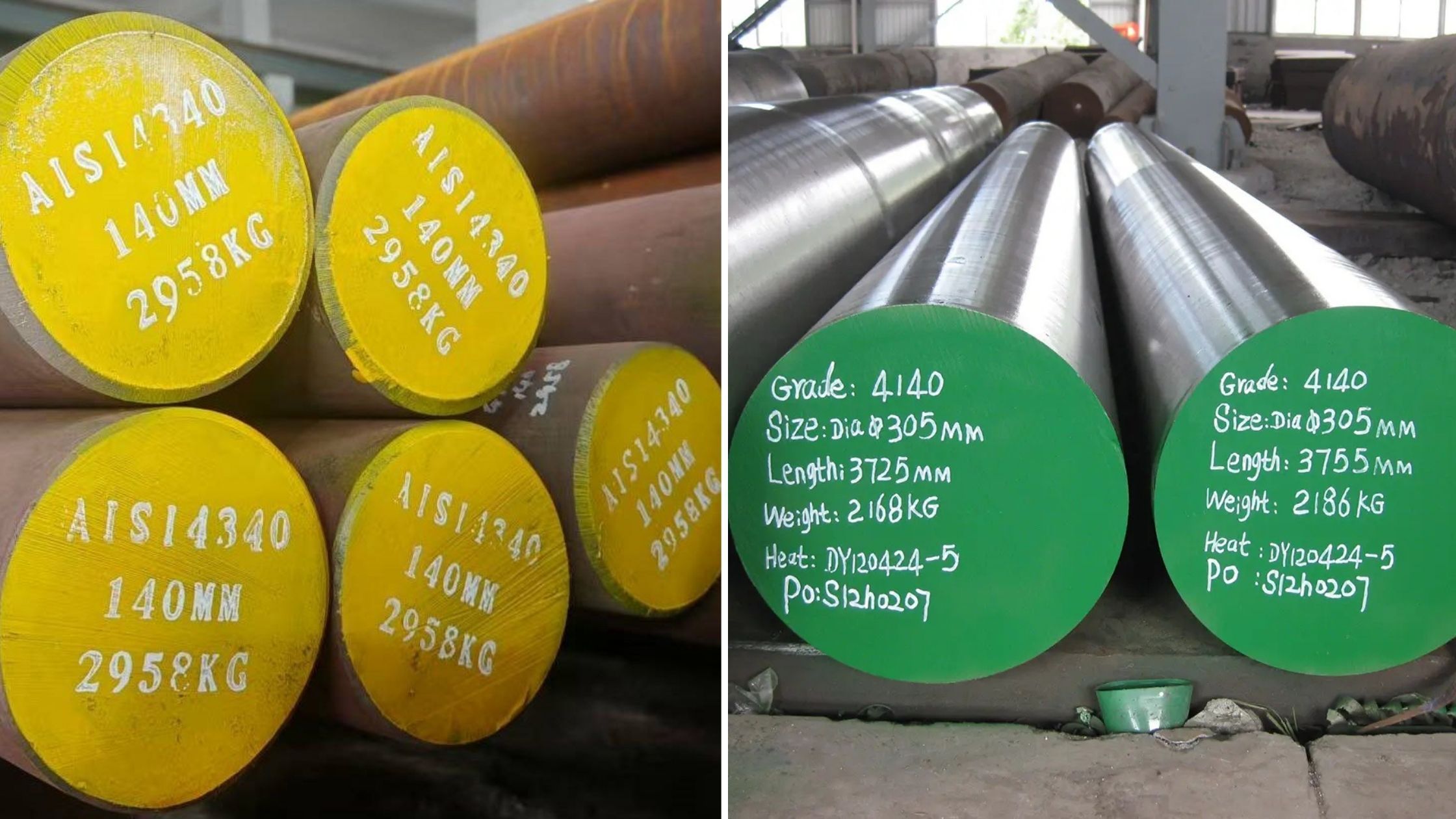
The heat number (or lot/batch number) is one of the most critical elements on an MTC. It is a unique alphanumeric code assigned to a specific quantity of material produced from a single "heat" or melt in the furnace. This number provides complete traceability, linking the finished product back to its precise manufacturing process. All tests reported on the MTC are specific to this heat number.
5. Chemical Composition
This section details the material’s chemistry, listing the percentage by weight of each constituent element (e.g., Carbon, Silicon, Manganese, Chromium, Nickel, Molybdenum). The results are compared against the required ranges defined by the material standard. The chemical properties listed here confirm that the material meets the grade's specified formulation, which is essential for performance attributes like corrosion resistance and strength.
6. Mechanical Properties
Here, the MTC reports the results of physical tests performed on samples from the heat number. These tests measure the material's response to applied forces and confirm its suitability for mechanical applications. Key properties include:
- Tensile Strength: The maximum stress the material can withstand before breaking.
- Yield Strength: The stress at which the material begins to deform permanently.
- Elongation: The percentage of stretching the material can endure before fracturing, indicating its ductility.
- Hardness: The material’s resistance to surface indentation (e.g., Brinell, Rockwell hardness).
- Impact Test (e.g., Charpy): The material's toughness or ability to absorb energy at a given temperature, which is critical for low-temperature applications.
7. Heat Treatment Details
If the material underwent heat treatment (e.g., annealing, normalizing, quenching, and tempering), this section describes the process. It will specify the temperatures, duration, and cooling methods used. Heat treatment is performed to alter mechanical properties, making this information vital for ensuring the material has the desired strength and durability.
8. Manufacturing Route
This section may outline the production process, such as whether the material was hot-rolled, cold-drawn, forged, or cast. This information provides insight into the material's grain structure and resulting properties.
9. Test Results & Non-Destructive Testing (NDT)
The MTC will state that the material has passed all required tests. If additional testing was performed, such as Non-Destructive Testing (NDT), the results will be reported here. NDT methods like ultrasonic testing (UT) or radiographic testing (RT) are used to detect internal flaws without damaging the material.
10. Certification and Signature
The final section contains a statement of conformity, affirming that the information provided is accurate and that the material complies with the specified standards. It must be signed by an authorized quality assurance representative from the mill, independent of the production department. This signature validates the authenticity of the certified mill test report.
Types of Mill Test Certificates: Understanding EN 10204
The European Standard EN 10204 is the globally recognized classification system for inspection documents, including MTCs. It defines the level of traceability and validation provided.
- Type 2.1 Certificate of Compliance: A declaration by the manufacturer stating that the products supplied comply with the requirements of the order, without including test results.
- Type 2.2 Test Report: A declaration of conformity with the order, which includes results of non-specific inspection (tests carried out on products made by the same process, but not necessarily from the same batch).
- Type 3.1 Inspection Certificate: This is the most common type of MTC. It is issued by the manufacturer and declares that the products are compliant with the order. Crucially, it includes specific test results from samples taken from the actual batch of material being supplied (identified by the heat number). The certificate is validated by the manufacturer’s authorized representative, who is independent of the manufacturing department.
- Type 3.2 Inspection Certificate: This certificate provides the highest level of assurance. It includes everything in a 3.1 certificate but adds validation by an independent third-party inspector or the purchaser’s authorized representative. The third party confirms that the testing was performed correctly and that the certificate accurately reflects the material properties.
Mill Test Certificate vs. Material Test Certificate: What's the Difference?
The terms "Mill Test Certificate" (MTC) and "Material Test Certificate" are often used interchangeably, but a distinction exists. A Mill Test Certificate is always issued by the original manufacturer (the mill) and is tied to a specific heat number. A Material Test Certificate is a broader term that can refer to any document reporting test results, which could be generated by a third-party lab or a distributor.
The key difference lies in the origin and traceability. An MTC provides a direct link to the production source.
Feature | Mill Test Certificate (MTC) | Material Test Certificate (General) |
| Issuer | The original material manufacturer (mill). | Can be issued by a manufacturer, distributor, or third-party laboratory. |
| Traceability | Directly tied to a specific heat number from the mill. | May or may not have direct traceability to the original heat number. |
| Scope | Covers chemical and mechanical properties from the specific production batch. | Can cover a wide range of tests, which may or may not be from the original batch. |
| Validation | Authenticated by the mill's quality assurance department (Type 3.1) or a third party (Type 3.2). | Validation varies depending on the issuer. |
| Standard | Typically conforms to EN 10204. | Conformance to standards may vary. |
For applications requiring strict quality control, a certified mill test report (specifically a Type 3.1 or 3.2 MTC) is the required standard.
Nifty Alloys supplies materials only from mills that issue authentic MTCs compliant with global standards. We ensure complete traceability for all our products, including our extensive inventory of Alloy Steel Products and Stainless Steel Products.
Why MTCs Matter in Demanding Industries
In sectors like oil & gas, aerospace, fabrication, and power generation, material failure can have catastrophic consequences. MTCs provide the necessary assurance that materials will perform as expected under extreme conditions.
- Engineering and Fabrication: Ensures that structural components possess the required tensile strength and ductility.
- Oil & Gas: Verifies that materials used for pipelines and pressure vessels have the correct chemical properties to resist corrosion from harsh chemicals and environments.
- Aerospace: Confirms that alloys meet stringent strength-to-weight ratios and can withstand extreme temperatures.
Common Mistakes to Avoid When Reading an MTC
Even experienced professionals can make errors. Be vigilant for these common mistakes:
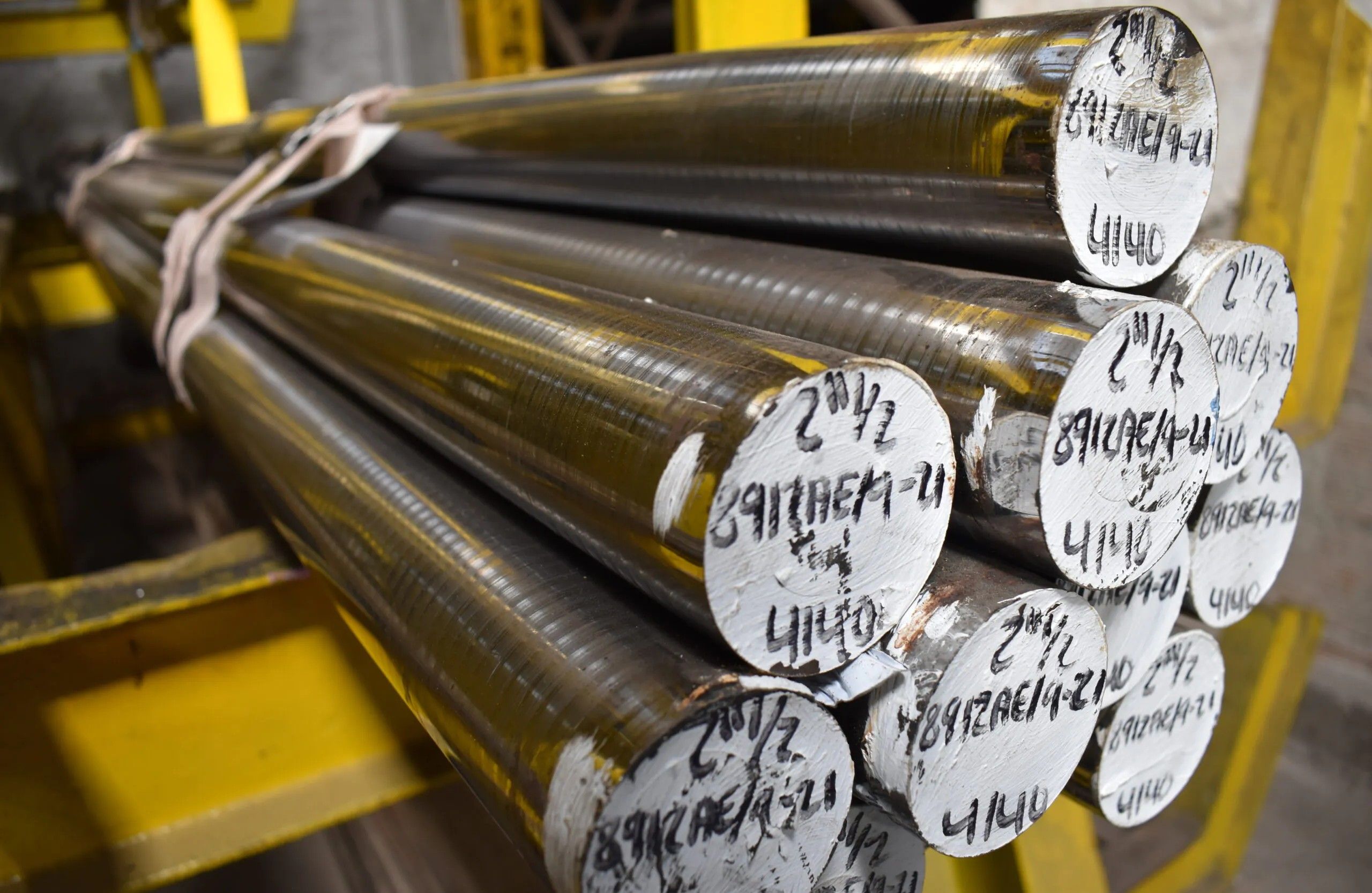
- Not Matching the Heat Number: Failing to verify that the heat number on the MTC matches the number physically stamped on the material.
- Ignoring Specification Revisions: Using an outdated version of a standard to check compliance. Standards are updated periodically.
- Misinterpreting Units: Confusing metric (MPa) and imperial (psi) units for mechanical properties.
- Overlooking Test Conditions: Not noting the temperature at which an impact test was conducted, which is critical for low-temperature service.
- Accepting a Type 2.2 for a 3.1 Requirement: Using a certificate with non-specific test results when the project demands specific batch testing.
Our range of Carbon Steel Products and high-performance Tool Steel Products is always supplied with the correct documentation to prevent such errors.
How to Verify a Certified Mill Test Report
To ensure an MTC is genuine:
- Check for All Required Sections: A legitimate MTC will include all the key fields discussed above, from supplier details to a clear certification statement.
- Confirm the Heat Number: The heat number on the document must physically match the marking on the material.
- Review for Consistency: Ensure there are no contradictions within the document. For example, the material grade mentioned should align with the chemical composition results.
- Validate the Issuer: Confirm that the issuing mill is a reputable manufacturer.
- Request a Type 3.2 Certificate: For critical applications, specifying a Type 3.2 certificate adds an independent layer of verification.
Sample MTC Fields & How to Interpret Them
MTC Field | What It Means | How to Interpret It |
| Heat No: X-12345 | Unique identifier for the production batch. | This is the primary key for traceability. Match this number to the physical material. |
| Chemical Analysis (Wt %) | Elemental composition of the material. | Compare the reported percentages to the ranges allowed by the specified material standard (e.g., ASTM A182). |
| Tensile Strength: 590 MPa | The maximum stress the material can handle before fracture. | Verify this value meets or exceeds the minimum requirement set by the standard. |
| Yield Strength: 280 MPa | The point at which the material starts to deform permanently. | Ensure this value is within the acceptable range for the material grade. |
| Elongation: 45% | How much the material can stretch before breaking. | A higher percentage indicates greater ductility. Check against the standard's minimum. |
| Heat Treatment: Annealed | The thermal process applied to the material. | This tells you the material's final metallurgical condition, affecting its hardness and machinability. |
Frequently Asked Questions (FAQs)
- What is a Mill Test Certificate (MTC)?
A Mill Test Certificate (MTC) is a quality assurance document issued by a material manufacturer that certifies a material's chemical and mechanical properties. It confirms that the material complies with specific international standards and provides full traceability through a unique heat number. - How do you read the chemical composition on an MTC?
The chemical composition section lists elements (like C, Mn, Cr, Ni) and their corresponding weight percentages. To read it, compare these values to the acceptable ranges defined in the material specification (e.g., ASTM or EN standards) listed elsewhere on the MTC to ensure the chemical properties are compliant. - What is the difference between a mill test certificate and a material test certificate?
A mill test certificate is specifically issued by the original mill that produced the material and is tied to a unique heat number. A material test certificate is a broader term for any document showing test results and could be issued by a distributor or a third-party lab, without the same level of direct traceability as an MTC. - How can I verify if an MTC is genuine?
To verify a genuine MTC, ensure the heat number on the certificate matches the number stamped on the material itself. Check that all sections are complete, the data is consistent, and the document is signed by an authorized quality assurance representative from a reputable mill. - Do all steel suppliers provide a certified mill test report?
Reputable suppliers providing materials for industrial and critical applications will always provide a certified mill test report, typically a Type 3.1 MTC. Suppliers who cannot provide this documentation may not be sourcing their materials from accredited mills, posing a risk to quality and compliance. - Why is the heat number so important in a material mill certificate?
The heat number is the single most important element for traceability. It links a specific product back to its exact production batch at the mill. This allows anyone to verify that the chemical and mechanical test results reported on the certificate correspond directly to the piece of material they have received.
Conclusion
The ability to read and interpret Mill Test Certificates is a non-negotiable skill for ensuring quality and safety in engineering and manufacturing. This document is the ultimate proof of a material's integrity, providing a detailed and verified record of its properties and origin. By carefully reviewing each section—from the heat number to the final certification—you can confidently verify that your materials meet the demanding requirements of your projects, safeguarding both performance and compliance.



Ras Al Khor Ind. Area-2, Dubai United Arab Emirtates
+971 565450916