Published: 2026-04-18 16:25:00

What Hardness (HRC) Do You Need for Tool Steel?

By akshai • Updated 2026-04-18 16:25:00

banner image

What Is HRC in Tool Steel?

HRC (Rockwell Hardness C scale) measures a material’s resistance to indentation and wear.

  • Higher HRC → better wear resistance
  • Lower HRC → higher toughness

In tool steels, hardness is achieved through controlled heat treatment, which transforms the material into a hardened microstructure suitable for industrial use.

Different tool steel grades are designed to operate within specific hardness ranges depending on application.

GradeTypical Hardness (HRC)Key PropertyApplication
O158–62Balanced toughnessGeneral tools
A257–62Dimensional stabilityPrecision dies
D255–62High wear resistanceCutting & stamping
H1346–52Heat resistanceDie casting
P2028–34Pre-hardenedPlastic molds

These values align with real industrial usage and grade characteristics .

Understanding Grades Through Real Applications

Instead of memorizing hardness values, it’s more useful to understand how each grade behaves in real-world applications.

For example, D2 tool steel is widely used in wear-intensive applications like cutting and stamping because of its high chromium content and excellent abrasion resistance

When the application involves high temperatures, such as die casting or extrusion, H13 tool steel becomes the preferred choice due to its ability to withstand thermal fatigue and repeated heating cycles

For mold manufacturing, especially plastic injection molds, P20 tool steel is commonly used because it is supplied in a pre-hardened condition, improving machinability and reducing processing time

If you want a deeper comparison between these grades, this guide explains it clearly: D2 vs A2 vs O1 vs H13 vs P20 Tool Steel – Differences & Uses

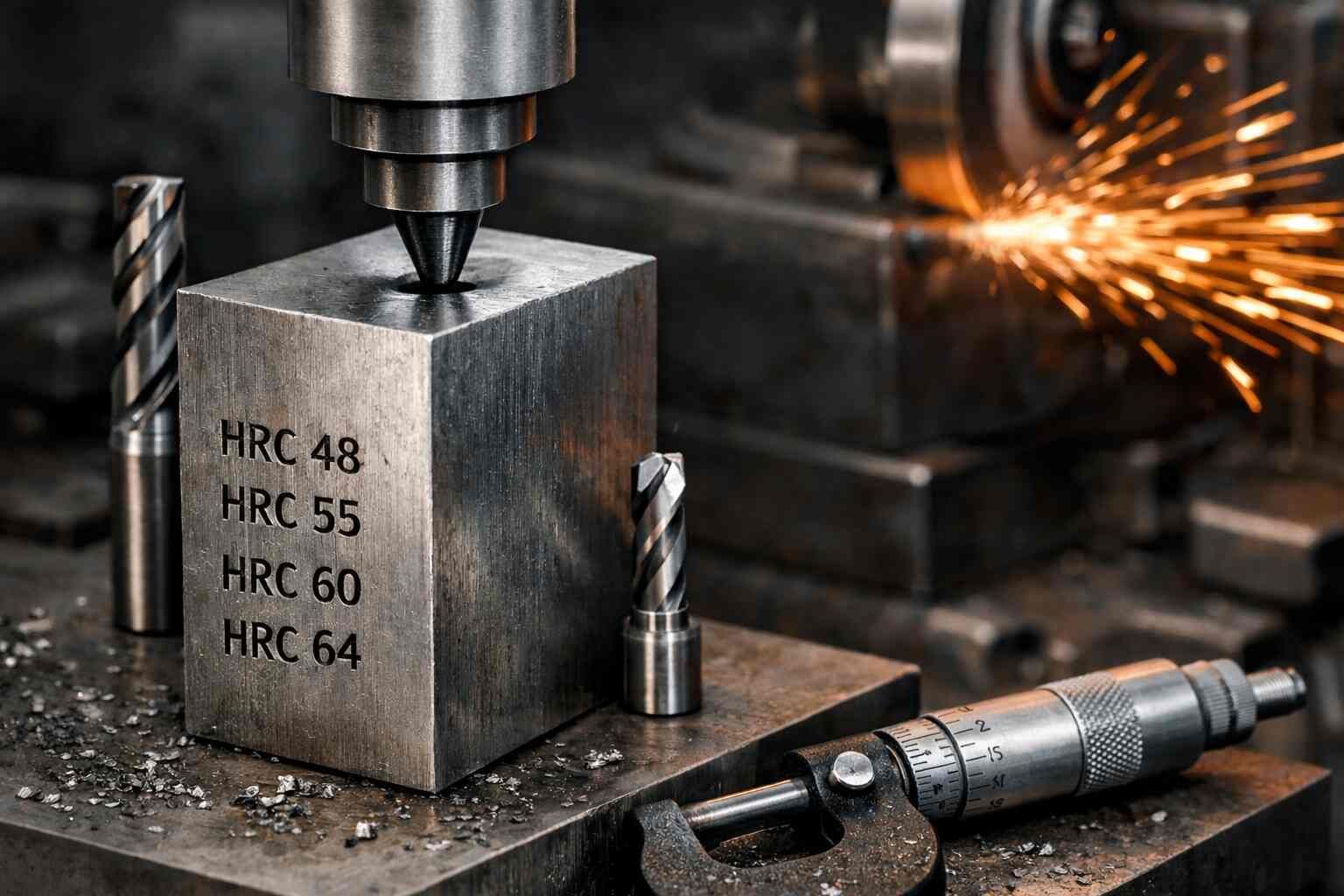
Hardness vs Toughness — The Critical Trade-Off

One of the biggest mistakes in tool steel selection is assuming that higher hardness is always better.

If hardness is too high:

  • Increased brittleness
  • Chipping under load
  • Reduced impact resistance

If hardness is too low:

  • Faster wear
  • Deformation under pressure
  • Shorter tool life

The goal is not maximum hardness — it’s the right balance for the application.

Cold Work Applications (Cutting, Stamping)

  • 58–62 HRC
  • Typical grades: D2, A2
  • Priority: wear resistance

Hot Work Applications (Die Casting, Forging)

  • 45–52 HRC
  • Typical grade: H13
  • Priority: heat resistance + toughness

Plastic Molds

  • 28–34 HRC
  • Typical grade: P20
  • Priority: machinability and polishability

High Impact Tools

  • 45–55 HRC
  • Typical grade: S7
  • Priority: toughness

How Heat Treatment Affects Hardness

Tool steel hardness is not fixed — it is achieved through heat treatment:

  • Austenitizing
  • Quenching
  • Tempering

Improper heat treatment is one of the leading causes of tool failure. Even a small variation in temperature can significantly change the final hardness and performance.

Real-World Selection Examples

Case 1: Stamping Die Failure

A D2 tool hardened to maximum hardness showed chipping issues. Reducing hardness improved toughness and extended tool life.

Case 2: Die Casting Tool

A high-hardness tool failed due to thermal cracking. Switching to H13 at a lower hardness solved the issue.

Case 3: Mold Manufacturing

Fully hardened steel caused machining problems. Switching to pre-hardened P20 improved productivity.

Common Mistakes to Avoid

  • Choosing maximum hardness blindly
  • Ignoring operating temperature
  • Not considering impact loads
  • Poor heat treatment control

Most failures are due to incorrect hardness selection, not material grade

How to Choose the Right Hardness (Quick Guide)

  • Need wear resistance → higher HRC (D2)
  • Need toughness → moderate HRC (A2, S7)
  • Need heat resistance → lower HRC (H13)
  • Need machinability → pre-hardened (P20)

Conclusion

Selecting the right tool steel hardness is about understanding the application — not just the number.

The correct HRC depends on:

  • Load conditions
  • Temperature
  • Wear requirements
  • Type of tooling

Choosing the right combination can significantly improve tool life, reduce downtime, and lower overall manufacturing costs.

Recent Posts